Scripture Reading: Matthew 3:1-12
In those days John the Baptist came preaching in the wilderness of Judea, “Repent, for the kingdom of heaven is at hand.” For this is he who was spoken of by the prophet Isaiah when he said,
“The voice of one crying in the wilderness:
‘Prepare the way of the Lord;
make his paths straight.’”
Now John wore a garment of camel's hair and a leather belt around his waist, and his food was locusts and wild honey. Then Jerusalem and all Judea and all the region about the Jordan were going out to him, and they were baptized by him in the river Jordan, confessing their sins.
But when he saw many of the Pharisees and Sadducees coming to his baptism, he said to them, “You brood of vipers! Who warned you to flee from the wrath to come? Bear fruit in keeping with repentance. And do not presume to say to yourselves, ‘We have Abraham as our father,’ for I tell you, God is able from these stones to raise up children for Abraham. Even now the axe is laid to the root of the trees. Every tree therefore that does not bear good fruit is cut down and thrown into the fire.
“I baptize you with water for repentance, but he who is coming after me is mightier than I, whose sandals I am not worthy to carry. He will baptize you with the Holy Spirit and fire. His winnowing fork is in his hand, and he will clear his threshing floor and gather his wheat into the barn, but the chaff he will burn with unquenchable fire.”
Prepare the Way of the Lord: An Advent Sermon on John the Baptist
Matthew 3:1-12 | Second Sunday of Advent
Sermon Date: December 7, 2025
Grace, mercy, and peace be unto you from God our Father and from our Lord and Savior Jesus Christ. Amen.
The lesson for meditation is Saint Matthew chapter three, verses one through twelve, with special focus on the words: "Prepare the way of the Lord."
Meeting John in the Wilderness
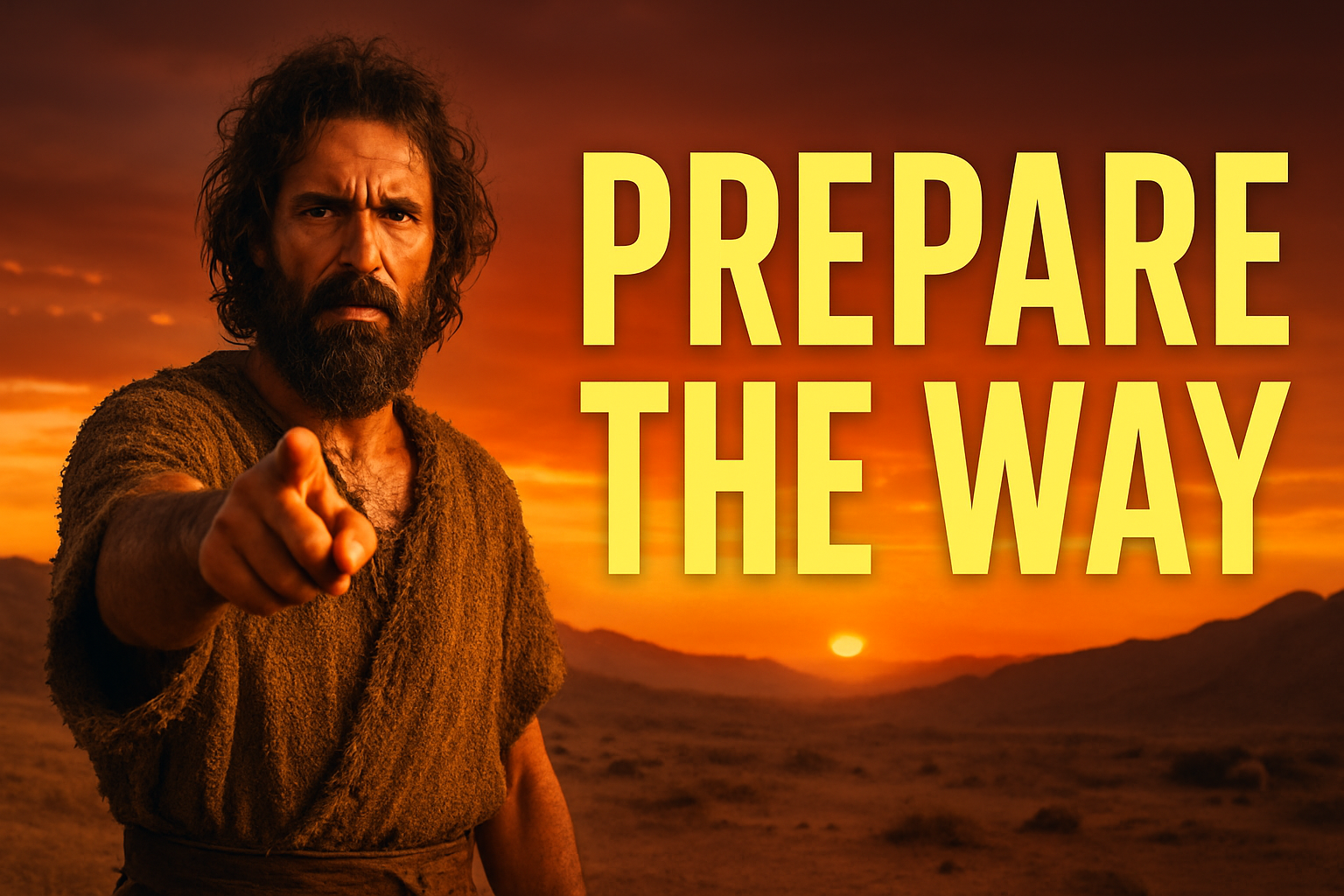
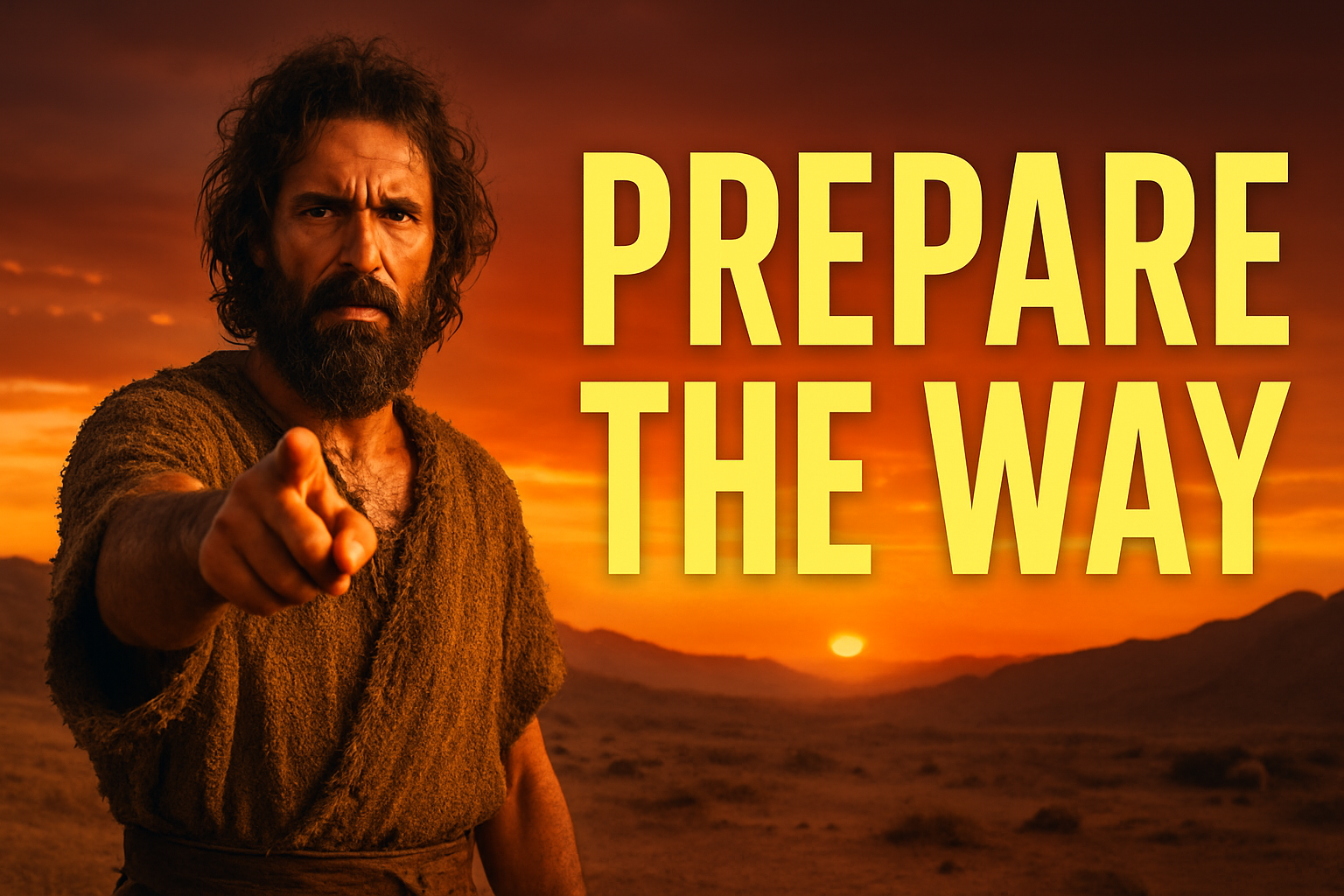
Imagine yourself standing in the wilderness across the Jordan River. You hear a voice calling, shouting from a distance: "Prepare the way of the Lord!" And then you see a figure approaching in the distance. He's a wild-haired, bearded man, his skin bronzed by the sun, his eyes ablaze with prophetic fire. He is dressed like a prophet straight out of the pages of the Old Testament—camel's hair, leather around his waist. And if you didn't know better, you'd swear it was Elijah come back from heaven.
And then you realize that you are standing on the very spot where tradition says that Elijah was whisked off to heaven in a chariot a few centuries before. And then the strange figure draws closer to you. A silhouette becomes a shadow, a shadow becomes a face, and you hear these words: "Repent, for the kingdom of heaven is at hand."
And make no mistake—he's looking directly at you. Don't worry about your neighbor's sin just yet. He's pointing a long index finger in your direction, saying, "Prepare ye the way of the Lord," or "Repent," which is quite the same thing. And he means you—the religious one, the pious Israelite, the unbaptized, the baptized, the Pharisees, the Sadducees, the scribe, the tax collector, the prostitute, the sinner. Yes, absolutely everybody. Does it matter who or what you are? Repent.
Who Is This Wild Prophet?
Who is the strange man with this funny wilderness diet who suddenly became the main preacher for Advent in the church year? Who sent him? Well, his name is John. And I dare say that any congregation looking to call a pastor, looking at a stack of paperwork, would put John in the "no way, no how" stack. And yet he is the greatest of all the prophets.
As you all know, he is the son of Zechariah and Elizabeth. His parents were old, extraordinarily old when he was born. He was probably raised as an orphan in the wilderness, at least for part of his childhood, and he seems to want nothing to do with the Temple in Jerusalem. So he comes from priestly parents, but he is no priest. His business is at the Jordan River, for he came to baptize.
John's Radical Baptism
Now, to be sure, baptism was not entirely unknown at the time of John. And don't worry about our Trinitarian baptism just yet—that comes a little bit later. Indeed, there's evidence that the wilderness communities with which John was associated already had a form of baptism, or at least an entry rite with water. You were baptized in a way, for instance, when you became a Jew, an honorary Israelite. It was called proselyte or newcomer's baptism.
That made John's baptism something new, something different. The people that came from Jerusalem and all the regions of Judea were not newcomers to Judaism. Indeed, they were Jews, some of them religious leaders—the Pharisees who had their oral law, and the Sadducees, who denied the resurrection and really needed a resurrection through Holy Baptism.
So you can see why John's baptism drew such controversy. It came across to religious leaders of the day as an unauthorized sort of renegade thing. But maybe that was kind of the point, for John was calling Israel to be washed—and yes, implying that they were not washed and they desperately needed this baptism, for they were unclean.
Confronting the Religious Elite
And notice he singles out the religious leaders for the harshest treatment, saying, "You brood of vipers! That is, you bunch of snakes! Who warned you to flee from the coming wrath? Bear fruit in keeping with repentance. And don't start jabbering about how you have Abraham as your father, Abraham on your family tree. You can see it there, for God can raise up children for Abraham from these stones." That is to say, he can take an inanimate, lifeless object and make children of Abraham. No, we want children of God through repentance and faith. And it's all right here in the waters of baptism. Once again: Prepare the way of the Lord. Just prepare his way by repenting of your sins.
Well, you have to wonder what they thought. What do you think when someone says to you, "Repent"? Well, we probably usually think, "Well, repent of what? What did I do?" And then we go through the Ten Commandments, and we brag, at least to ourselves, about how we have supposedly kept all the Ten Commandments. Or we look back at the person calling us to repentance and say, "Hey, you shouldn't talk. You're the one who needs to repent."
But no, again I say, John is speaking ultimately first and foremost to you, to me, individually, first person or third person singular. There's a coming wrath. There is a coming judgment and fire. The time to repent is now.
The Last of the Old Testament Prophets
John's appearing in the Jordan wilderness, then, marks the end of the thundering prophets of the Old Testament in their call to repentance. Indeed, I hope you agree with me that John is basically the walking and talking Old Testament, what Luther called "the ultimate of all prophets and preachers."
The prophet Malachi, about four hundred years earlier, said that Elijah would come before the day of the Lord to prepare the hearts of the people. John, then, is this new and greater Elijah, the one who comes in the spirit of Elijah—no political correctness, no going with the whims and cultural fads of the day, no, just straight talk of the law in order to bring you to the gospel. Yes, the last of the Old Testament prophets who points to the long-expected Messiah and says, "He will soon be standing in this very Jordan River."
The Symbolism of Baptismal Washing
You know, I have this impulse that when something important happens, there's always usually some sort of a bath or a shower involved. You've all been to baby showers and bridal showers—I don't remember there was actually a shower, at least in the water sense of the phrase—or even when you wash your hands. And that's the notion behind Jewish baptism as they knew it in the day: you were leaving your old way of life, your old religious loyalties, everything. You are starting afresh, starting over, reborn as an Israelite, one of God's people.
But what John was doing was calling Israel to be washed and ready for the coming one, the Messiah—calling Israel out of the land, away from Jerusalem, away from the temple and its religious institutions, and back into the wilderness. And kind of an exodus in reverse.
As you all know, the original Exodus was out of Egypt through the wilderness, then crossed the Jordan into the Promised Land, and then built the temple. However, in the past few hundred years leading up to John, they had lost track of the coming suffering Messiah. So John now calls them the other direction—from the temple, out into the wilderness, back to the Jordan, to consider what happened in that great redemptive event in the Old Testament, to be baptized and now to live it out. For the Messiah is coming.
Living Out Your Baptism
And that's what repentance is. It's going back to that baptismal font, seeing how you have sinned against God. And of course, no need to be rebaptized, but to live out your baptism this Advent in daily repentance and faith.
The baptism you receive, of course, is a little different than John's in that it came from Jesus with a fiery Pentecost wind of the Holy Spirit and the full name of the Holy Trinity. John's baptism was fulfilled when Jesus stood in the water before John to be baptized by him, when the heavens were opened and the Spirit descended, and the Father said, "This is my beloved Son." And John said, "Behold the Lamb of God, who takes away the sin of the world."
That was the purpose of John's baptism—to prepare the way for Jesus' coming in humility, to die and to rise. But the purpose of your baptism is to prepare the way for Jesus' final coming, his final advent in glory, when he will raise the dead and give salvation to you and join you with Jesus now in his death and life, that you might die and rise with him forever. Yes, your baptism is fulfilled the day you die, and on the last day when you rise. It all points ahead to that final advent.
So John's baptism was for that time only. It was a baptism of water with repentance. Jesus' baptism with water in the name of the Trinity lasts until the end of time.
Old Testament Gospel in New Testament Form
I'd like to say that John brought Old Testament Gospel in New Testament form—Old Testament because it looked ahead to the Messiah, but New Testament because this is no circumcision. This is a washing with water. And so John preached Jesus as the promised coming one, the true Advent Lord.
It's striking, the kind of Jesus he preaches. I think you would agree, it's really not the one that shows up. John's Jesus has a winnowing fork in his hand and a fire of judgment kindled, and he's ready to toss the grain into the fiery wind and burn the chaff with unquenchable fire as he gathers up his wheat into the barn. And in this matter, it's important to note that Solomon's temple and the rebuilt temple under Herod was probably built, to our best knowledge, on an actual old grain threshing floor—the place where you throw the crop up into the air, the wind would take away the chaff, and the crop would come back to the floor. And that's exactly what's happening here with John as he calls them to repentance.
John's Jesus, then, has an axe already laid to the root of every fruitless tree. Would you want to meet Jesus on those terms without repentance? I would not, for we would be under the fiery wrath to come.
The Unexpected Messiah
Yet when Jesus actually does appear—and more about that this coming Epiphany—he appears humble and meek. He submits himself willingly to John's baptism of repentance, even though he was the one perfect man who had no need for repentance. Instead of an axe and a winnowing fork, he comes with a cross and death. Instead of judgment, as we think of the word, he comes to be judged by his own Father.
And it's no wonder that John at one point had his doubts and had to ask if he really was the right candidate, or if they needed somebody else for the job. Gentle Jesus hardly seems to fit the bill, but that's precisely the point. Jesus comes as gospel to John's law. Yes, John's law—the prophetic word prepares for the word from Jesus, which is the gospel.
Who would have known that the axe of God's wrath would be laid against the promised shoot from the stump of Jesse when he went to the cross? Who would have known that the fire of God's judgment would be turned against his own Son in his passion to save you and to save me and the world? Who would have known that the way of the kingdom of heaven is for the King to die for his subjects, and then to rise from the dead and say, "Your sins are forgiven"?
So it's not so much that we get to go up to God, per se, but first and foremost that God comes down to us with life and salvation in Christ.
Isaiah's Vision Fulfilled
About seven hundred years before John, the prophet Isaiah saw the coming kingdom and described it as a tiny shoot springing from the stump of King David's family tree, and from that sprout a righteous branch that would bear much fruit. The Spirit of the Lord would rest upon him. As you already heard today, he would judge the world by his righteousness and restore harmony and shalom—peace—to the creation, so that even the wolf and the lamb could lie down in peace.
Isaiah saw a day when the root of Jesse would become a banner lifted high, a signal for all the peoples, whose resting place would be glorious. And from its humble beginnings to his glorious ending, the sprout becomes a branch that becomes a tree from whose fruit you may eat and live, even today, as you receive the Blessed Sacrament and the fruits of salvation itself.
John's Blessed Finger
Martin Luther said of John the Baptist: not because of his austere life, not because of his phenomenal birth, but because of his blessed finger, because of his message and office. "No other man has such fingers as John's, with which he points to the Lamb of God and declares that he is the true Savior who would redeem the world from sin."
Amen to that.
Conclusion: Prepare the Way
So prepare the way of the Lord this Advent, dearly beloved. Yes, prepare his way through daily repentance and faith, as you behold the Lamb of God who takes away the sin of the world. God grant it unto you for Jesus' sake. Amen.
The peace of God, which passeth all understanding, keep your hearts and minds through faith in Christ Jesus our Lord. Amen.
Find us on Youtube, Apple Podcasts, or Spotify.